


We have cleaned up the model offer so that only the current generation remains. The default model for new conversations is GPT-6.1 Sol, the successor of GPT-6 Sol with the same focus: high quality for professional writing and complex analysis at a reasonable price. GPT-6 Astra stays for the most demanding tasks and GPT-6 Luna for fast, high-volume work.
What is on offer
Next to the GPT-6 line the model picker now carries the whole Claude 5.5 line from Anthropic: Claude Opus 5.5 for the most complex analysis, Claude Sonnet 5.5 as the balanced model for everyday work and Claude Haiku 5.5 for quick tasks. Claude Fable 5.1 remains. From other providers you can choose Gemini 3.8 Flash, Muse Spark 1.3 and DeepSeek V4.1 Flash.
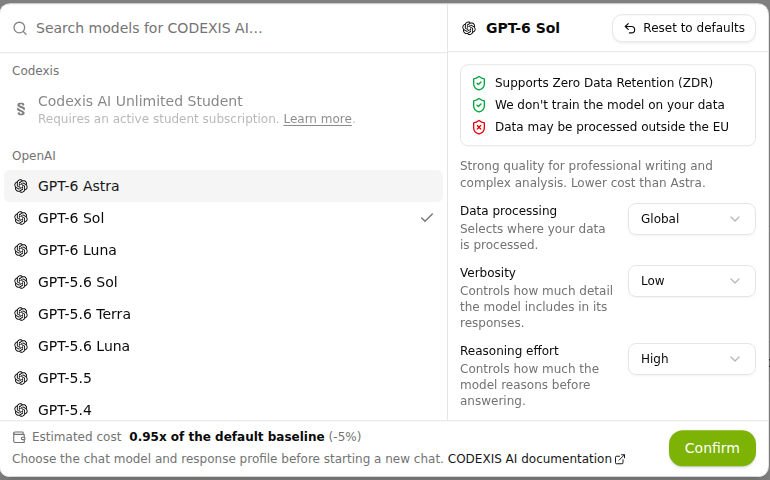
The picker is ordered from the strongest models to the economical ones, and each model shows a short description and its guarantees, that is whether it processes data in the EU and whether it has zero data retention. That tells you which model to trust with sensitive materials.
What happened to the older models
The GPT-5.6 line and the older GPT-5.5 have left the picker. Conversations that ran on them can still be opened and read. When you continue one, the answer is prepared by the default model GPT-6.1 Sol. There is nothing to reconfigure.
The offer depends on your license
If the administrator of your license restricted the choice to models with EU processing, zero data retention or a specific list of allowed models, you only see those. The others are greyed out with an explanation. How this setting works is described in the article on allowed models and the EU and ZDR requirements.
The model picker and the answer profile are described in the documentation on the Conversation page.